


You think you know Korea.
Red jumpsuits. The glass bridge. The cold, brutal arithmetic of Squid Game — a world where trust evaporates faster than people do. You’ve seen Parasite. That suffocating masterpiece about class and desperation and the violence that festers just below polished surfaces. Maybe you’ve even come across headlines about no-kids zones, and quietly folded away a small worry about what it might feel like to walk into a Korean restaurant with a toddler and a stroller.
That Korea is real.
It’s just not the whole story.
Right now, in theaters across North America, Korean audiences are doing something that doesn’t fit that picture at all.
They’re showing up in millions — 12 million tickets sold, which in a country of 51 million people isn’t a box office number, it’s a communal event — and they are weeping. Not at a revenge thriller. Not at a survival horror. They’re crying at a film about a rough-handed, inarticulate, thoroughly ordinary middle-aged man who does one simple and devastating thing:
He refuses to leave a child alone in the dark.
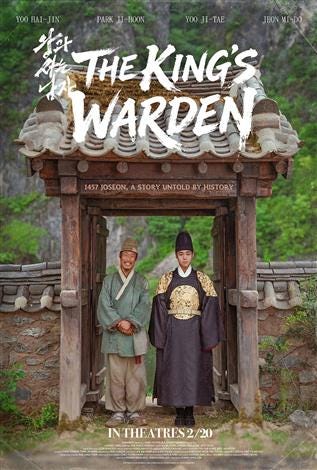
The film is The King’s Warden.
And if you want to understand why strangers in Korea keep quietly giving your kids things — the candy, the extra skewer, the bowl of rice nobody asked for — you need to understand the 500-year-old wound this movie tears back open.
The Boy No One Saved
Go back to 1455.
Korea’s most beloved king, Sejong the Great — the man who invented the Korean alphabet, reformed the tax system, and is today regarded as something close to a secular saint — is dying.
He has spent his final years watching his son deteriorate under illness and his dynasty begin to fracture. Before he closes his eyes, he gathers his most trusted ministers around a twelve-year-old boy. His grandson. The crown prince who will become King Danjong.
We don’t have a transcript. But in the historical imagination of Korea — in the films and dramas that have retold this moment for generations — the dying king’s words are always the same:
I do not ask you to surpass my legacy. I only ask you to make sure this child does not die alone.
They failed him.
Within three years of taking the throne, Danjong was deposed by his own uncle — Prince Suyang, who would become King Sejo. If you’ve seen Shakespeare’s Richard III, you already know the shape of this story. The difference is that in Korea, this isn’t fiction.
The boy-king was stripped of his title, exiled to a remote mountain valley, and at seventeen years old, ordered to drink poison.
He did as he was told.
The Man Who Stayed
The King’s Warden isn’t about the uncle who took the throne. It’s not about the political machinery that ground a child to dust.
It’s about Eom Heung-do.
Eom was not a warrior or a minister or a man of particular standing. He was a local official in the mountain district where Danjong was exiled — the kind of man who, in any Hollywood film, would have two lines and disappear. When the deposed king arrived in his valley, thin and frightened and surrounded by indifferent guards, everyone around Eom made the politically sensible choice.
They looked away.
Eom didn’t.
He brought the boy food. Warm food — the kind you make when you actually care whether someone eats it. He covered him with blankets at night. He sat with him. He couldn’t rescue him; the machinery of power was too large for that. But he refused to let the boy feel invisible.
If you’ve played The Last of Us, you know this emotional register exactly. Joel doesn’t save the world. He saves one person — at extraordinary cost, with no guarantee it changes anything. What makes that story unbearable and beautiful at the same time isn’t the heroism.
It’s the stubbornness of the love.
The refusal to calculate whether it’s worth it.
Eom Heung-do calculated nothing. He just stayed.
When Danjong died, Eom secretly gave him a proper burial — a capital offense under King Sejo’s rule. He did it anyway. History records that he was fully prepared to die for it.
Korean audiences aren’t crying at the film’s ending.
They’re crying because in the 500 years since, they became a society that still hasn’t forgiven itself for not being Eom Heung-do.
What Jeong Actually Means
There’s a Korean word with no clean English equivalent: 정 (jeong).
Translators reach for “affection.” Or “attachment.” Or “bond.” All correct. All insufficient.
Jeong is more like the emotional residue that accumulates between people who have shared time, food, hardship, or simply proximity — whether they chose to or not. You can develop jeong with a neighbor you initially found irritating. With a city you never meant to love. With a child who isn’t yours.
Jeong isn’t chosen. It accretes. And once it does, abandonment becomes almost physically painful.
The Danjong story is, at its core, a story about a community that failed to let jeong win — or that felt it, and then suppressed it out of self-preservation. Eom Heung-do is celebrated not because he was a uniquely good person. But because he was the one person who let the jeong win.
Korean scholars have argued that this wound sits surprisingly deep in the national psyche. In a society built around collective identity and the protection of the vulnerable, the boy-king’s abandonment remains in the cultural imagination like an unpaid debt.
The national instinct toward children — the coddling, the generosity, the insistence on feeding them — is, in part, a culture continuously trying to settle that account.
The Candy Is Not Just Candy
So.
You’re walking through Gwangjang Market with your toddler in a carrier. An elderly woman — she runs a vegetable stall, she doesn’t speak your language, she doesn’t need to — reaches across and presses a piece of hard candy into your child’s hand. She makes direct eye contact with the kid. Nods once, slowly, with great seriousness.
Like she’s completing a transaction of real importance.
She is.
She’s not being quaint. She’s not performing hospitality for your travel feed.
In the inarticulate language of jeong, she is telling your child:
I see you. You are not invisible here.
The restaurant owner who quietly brings a bowl of plain rice for the baby — nobody asked. The grandfather on the subway who stands up before you even notice him, because he spotted the stroller from across the carriage and his feet moved before his brain caught up. The street vendor who gives your kid a second skewer and waves off your thanks with a gesture that means don’t mention it, this is just what you do.
This country is not unaware of its no-kids zone debate. That tension is real, and it reflects genuine friction in a society going through rapid, disorienting change. But it exists alongside — and in some ways in reaction to — something much older and much deeper.
A reflex that says: We left a child alone once.
Never again.
From One Local Dad to You
Before you pack the stroller and book the flights, here’s what I want you to know.
Korea will not treat your child as an inconvenience to be managed. It will treat your child as something closer to a small sovereign — a little king or queen whose presence is, in some ancient and not entirely rational way, a privilege to witness.
You will be given things you didn’t ask for.
Your child will be addressed before you are.
Adults with absolutely no personal stake in your family’s happiness will go briefly but genuinely out of their way to make sure your kid is okay — fed, warm, seen.
This isn’t performance. It isn’t customer service.
It is 500 years of Koreans trying to be the person Eom Heung-do was — staying when staying was hard, offering warmth when warmth cost something, refusing to look away from a child who might otherwise feel alone.
The King’s Warden never saved the boy.
But he made sure the boy knew he was seen.
Your family will be seen here.
I promise.
If this changed how you see the stranger who smiles at your kid on a Seoul street — share it. That’s how this community grows.