


People preparing for a trip to Korea want to know about a lot of things. Hotels, transport, weather, itineraries. But no matter the nationality, the age, the family setup — one question appears without fail.
“What should we eat there?”
Fair question. Food is the fastest, most direct way to actually touch a country’s culture.
Bibimbap, samgyeopsal, chimaek — the world already knows. This field note doesn’t cover that ground. Dishes so well-documented that no one needs a local to find them are outside this brief.
What’s in here is different. These are the places where a local takes a foreign friend and watches their eyes go wide. Where one bite produces silence. Where the meal ends and someone says, “I had no idea this existed” — and means it. Things you don’t find without someone on the inside.
How to use this note: ★ is a verified family pick. 🏠 is the local dad’s off-menu route. No need to read in order. Open to whatever situation you’re in right now.
The thing you’ll remember longest about Korea isn’t the palace or the night view. It’s the table. The moment the whole family sat down and tried something for the first time — your child’s face when they first tasted ggul-tarae, the warmth of hands passing hotteok back and forth on a winter street.
This field note was opened for those moments.
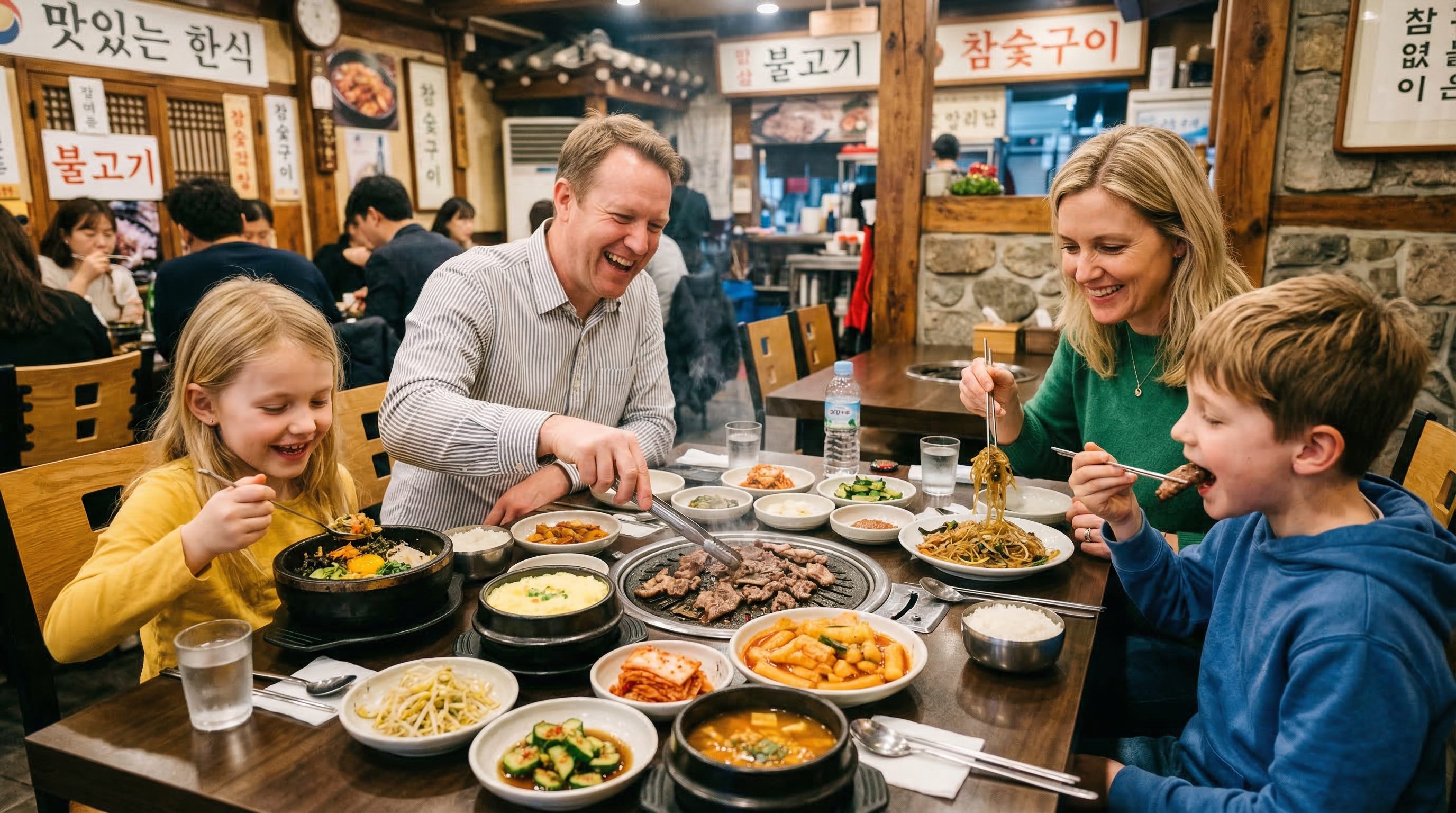
1. Spice Recon: Mapping the K-Meat Territory
Not all Korean food is spicy. But you need the map before you enter.
Level 0 — “Nothing Red. Ever.” (Zero-Spice Premium Zone)
★ Hanwoo Charcoal BBQ(한우숯불구이)Hanwoo beef isn’t about marbling — it’s about depth of flavor. Why can’t you get it abroad? Strict quarantine regulations and domestic demand so overwhelming that export is nearly nonexistent. A limited-edition culinary experience available only on Korean soil. Grill lightly. Dip in salt. No sauce needed.
★ Seolleongtang(설렁탕) Ox bone broth, simmered for hours until it turns milky white. Put it over rice and set it in front of a child. Most of the time, the bowl disappears. Salt is adjusted at the table — safe for any age. Korea’s oldest comfort food.
🏠 Local Dad’s Route — Sagol Tteok-mandu-guk(사골떡만두국) This one rarely makes the menu, which is why most visitors miss it. Rich bone broth, chewy rice cakes, generously filled dumplings. Children get absorbed in fishing out the dumplings. Adults finish the broth quietly. Both leave satisfied.
Local Intel — Why Hanwoo? Hanwoo is a native Korean cattle breed. Export volumes are negligible, making it virtually impossible to source outside Korea. Prices at restaurants reflect this — but once you know about Majang-dong, the calculus changes.
Level 1 — “A Gentle Challenge” (Mild Heat, Manageable)
★ Tteok-Twi-Sun(떡튀순) The unofficial holy trinity of Korean street food ordered as one: tteokbokki (spicy rice cakes), twigim (assorted tempura), and sundae (blood sausage stuffed with glass noodles). It arrives together, gets eaten together, and disappears faster than expected.
💡 Can’t handle spice at all? Try Gungjung Tteokbokki (궁중 떡볶이) — the original royal-court version made with soy sauce instead of gochujang. It’s mild, slightly sweet, and a genuine gateway into tteokbokki culture without the heat. Ask for 간장 떡볶이 or 궁중 스타일.
★ Yuks-sam Naengmyeon(육쌈냉면) Hot charcoal beef meets cold buckwheat noodles. Sounds wrong. Tastes immediately right. Wrap the meat in the noodles and eat in one bite — this is the Korean summer dining equation.
🏠 Local Dad’s Route — Yukhoe :Beef Tartare(육회) Don’t let “raw beef” close the conversation. Thinly sliced fresh Hanwoo, tossed with Korean pear. Sweet, nutty, tender. The children who hesitated on the first chopstick reach for the second without being asked.
🏠 Local Dad’s Route — Jokbal & Bossam(족발 & 보쌈) Two dishes. One table. The most satisfying eating format in Korea.
Jokbal — pig’s trotters braised low and slow in a soy-ginger-garlic brine until the collagen dissolves completely. Sticky, rich, deeply savory. Served cold, dipped in fermented shrimp paste. Bossam — pork belly boiled until just tender, sliced thin, wrapped in salted napa cabbage with fermented paste and raw oysters. Where jokbal is intense, bossam is clean and delicate.
The wrap is the point. Place meat in a cabbage leaf, add a small amount of paste, fold, eat whole. One bite. Everything resolves at once. Children take to the wrapping format immediately — it gives them control, and the bossam pork is mild enough for any palate. Start with bossam. Let jokbal come in its own time.
Local Intel — Jangchung-dong Seoul’s jokbal tradition lives in Jangchung-dong Jokbal Alley (장충동 족발 골목), near Jangchung Park. Dozens of restaurants, each with their own brine formula refined over decades. Order the 족발보쌈 세트 (set). Line 3 — Dongguk University Station (동국대입구역), Exit 3.
2. Family Provisions: One-Bowl Dishes for the Whole Table
One pot, one pan, one bowl — shared from the center. This is how Korean families eat.
★ Haemul Pajeon(해물파전) — Seafood Scallion Pancake Divided like pizza, eaten with hands. The crispy texture distracts children from the fact that they’re consuming vegetables. Koreans seek out pajeon spots on rainy days — a ritual worth joining.
★ Dak-hanmari(닭한마리) — Whole Boiled Chicken One whole chicken in a clean, mild broth. Not spicy. Not heavy. Add kalguksu noodles to the broth at the end. The communal boiling at the table is its own entertainment for children.
🏠 Local Dad’s Route — Deulgae Sujebi(들깨수제비) Most people in Seoul don’t know this one either. Perilla seed broth — richer and more fragrant than any cream soup — with hand-torn dough pieces cooked inside. Children respond to the nuttiness. Parents go quiet after the first bowl. That’s the tell.
🏠 Local Dad’s Route — Gamjatang(감자탕) A deeply rich pork backbone stew slow-cooked with potatoes, perilla leaves, and fermented soybean paste. The meat falls off the bone. It arrives in a stone pot, still bubbling. It’s messy, communal, and completely worth it. This is a late-night staple and a hangover remedy in equal measure — order it as the main dish for the table, ask for extra potatoes (감자 더 주세요), and save the broth for last.
★ Budae-jjigae(부대찌개) Born in the years after the Korean War, when American military surplus — Spam, hot dogs, baked beans — found its way into Korean kimchi broth. The result is one of the most deeply satisfying fusion dishes on earth, and it happened by accident. Ham and sausage for the children, deep spiced broth for the adults. Add ramen noodles halfway through. Eat it before it stops bubbling.
3. Mobile Provisions: The Street Food Route
In Korea, snacks aren’t items on a menu. They’re experiences that happen while you’re walking somewhere else.
Sweet Route
★ Ggul Hotteok(꿀호떡) — Honey Pancake The defining street snack of Korean winter. Honey and crushed nuts inside a warm, chewy pancake. It’s too hot to eat immediately — blowing on it together is the point.
★ Bungeoppang(붕어빵) — Fish-Shaped Pastry Red bean or cream custard inside a fish-shaped shell. Buy one and your child will request a second before finishing the first. Save time. Buy two.
🏠 Local Dad’s Route — Ggul-tarae(꿀타래) The process of pulling 16,000 honey threads from a single lump of sugar is a performance in itself. Children don’t look away. The most dramatic possible introduction to Korean traditional confectionery.
Savory Route
★ Gyeran-ppang(계란빵) — Egg Bread A whole egg baked inside a soft, slightly sweet bread roll. Adequate as a walking breakfast. Excellent as an energy reset between destinations.
★ O-deng or E-Mok (꼬치 오뎅) — Skewered Fish Cake Soft fish cakes threaded on wooden skewers, simmered in a savory kelp-anchovy broth. The broth itself is served warm in a small cup — free, always, without asking. One of Korea’s great unsung street experiences. The fish cake is mild, the broth is restorative, and the whole thing costs almost nothing. Children find it immediately approachable. Adults find themselves going back for the broth.
🏠 Local Dad’s Route — Roasted Sweet Potato & Chestnuts(군고무마, 군밤) Zero additives. Nothing added. A bag of each, eaten while walking — this is the scene Korean parents remember from their own childhoods. You’re not buying snacks. You’re stepping into that memory with your family.
4. Field Positions: The Food Alley Deployments
These are places where choosing a restaurant becomes irrelevant. The street is the menu.
★ Sindang-dong Tteokbokki Town(신당동떡볶이타운) The original home of instant tteokbokki. Order jjajang tteokbokki for the children — mild, savory, manageable. Adults get the spicy version. One table, two missions, everyone covered.
★ Uijeongbu Budae-jjigae Street(의정부부대찌개거리) A dish born from the Korean War — ham, sausage, and ramen in a rich, savory broth. Adults find the depth; children find the ham and noodles.
★ Dongdaemun Grilled Fish Alley(동대문생선구이거리) The entire alley smells of charcoal-grilled fish. Mackerel prepared the way it should be. Families who swore their children didn’t like fish have been surprised here more than once.
🏠 Gwangjang Market(광장시장) — Bindaetteok & Mayak Gimbap(빈대떡, 마약김밥) Mung bean pancakes and one-bite rice rolls in one of Seoul’s most alive market atmospheres. The artisans from the Netflix documentary are here, in person, working. Watching is a show. Eating after is the reward.
🏠 Majang-dong Hanwoo Alley(마장동 한우골목) The freshest, highest-quality Hanwoo in Seoul at prices that make restaurant markups feel unreasonable. Select the cut yourself, grill it on-site. The selection process alone is an event for children who have never watched someone choose their own meat.
🏠 Jangchung-dong Jokbal Alley(장충동 족발골목) Seoul’s oldest and most serious jokbal destination, a short walk from Jangchung Park. Dozens of restaurants, hand-painted signs, steam rising at all hours — each place running its own brine recipe refined over thirty, forty, fifty years. Order the 족발보쌈 세트 and let the table work through both. Line 3 — Dongguk University Station (동국대입구역), Exit 3. Walk toward Jangchung Park, about 5 minutes. Follow the steam.
★ Sinlim-dong Sundae Town(신림동 순대타운) Seoul’s largest sundae destination — an entire neighborhood built around one dish. The sundae here is not the thin slice served beside tteokbokki at a street stall. This is the real thing: thick casings packed with glass noodles and tofu, a platter of assorted offal, and a bowl of rich, milky sundae soup made from the same pot. Order the 모둠순대 (assorted platter) and 순댓국 (sundae soup) together — that’s the move. The soup is the sleeper hit: deeply savory, restorative, impossible to leave unfinished. Children who are skeptical of the concept tend to start with the glass noodle-filled pieces — the right entry point. Line 2 — Sinlim Station (신림역), Exit 3. Five minutes on foot.
If this field note made your family’s Korean table a little richer — pass it to a parent planning their first trip. The local dad keeps updating.
🍽️ Two Field Tools — Use Them at the Table
Reading the brief is one thing. Executing the order under pressure is another.
At the table, you need two things:
Sik-gu Dining Cards — Photos and descriptions of all 8 essential banchan, Korean pronunciation on tap, emergency ordering phrases. For when the food has arrived and you need to know what you’re looking at.
K-Family Dining Logistics — The complete menu field guide: 15 dishes across every category, 7 food alleys with directions, spice levels, stroller ratings, and local dad tactics. For when you’re deciding where to go and what to order before you sit down.
Both work offline once loaded. No internet required at the table. This is the local dad’s field kit — take both in with you.